
Wildlife in the Cantabrian Mountains
Wildlife watching
and safari
Immerse yourself in nature,
observing the interactions between species and
their behaviour in the wild.
-
Montaña de Riaño
and the Cantabrian Mountains. - Late July to late April
- 1 to 3 people per guide.
-
Species distance
400–1,000 m - 500–600 mm telephoto lenses with a 1.4x teleconverter.
- Sunrise and sunset.
- Moderate (high mountains, cold temperatures).
- Photography and Observation
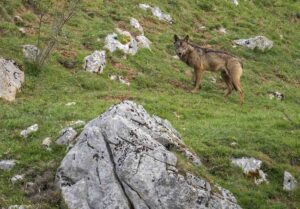
This activity involves morning and afternoon stakeouts at locations from which wolves can be spotted at distances ranging from 400 to 1,000 metres, allowing high-quality photographs to be taken using high-magnification lenses. These images often capture scenes of great documentary value, as can be seen in numerous productions and films about wolves shot in the Riaño Mountains with our collaboration.
This activity complements hides, and is ideal for those wishing to understand the natural behaviour of wolves. These excursions are conducted with an ethical approach, prioritising the welfare of the species and minimising disturbance.
The activity is best enjoyed from late July to mid-November.
During this period, wolf packs include the year’s pups, which increases the number of individuals and, consequently, the chances of spotting them.
In summer, wolf cubs are still easily distinguishable from adults and tend to be more active, playing together. In autumn and winter, wolves sport their characteristic thick coat, which makes for even more striking and spectacular photographs.
There have been good opportunities to spot bears in the Riaño Mountains in recent years, and this is likely to continue as the population in this Regional Park is clearly on the rise. However, the best viewing areas are located in the western part of the Cantabrian Mountains, so we usually travel to other natural areas to work with this species.
The Cantabrian brown bear inhabits a variety of mountain habitats (beech and oak forests, blueberry thickets, high-altitude grasslands and areas with wild fruit trees) depending on the time of year and the availability of food. For this reason, on each outing we select the most suitable locations to maximise the chances of spotting the species, always with respect and keeping a safe distance.
To enjoy this activity, we recommend wearing a telescopeHowever, bears can sometimes be spotted in closer locations, and it is possible to capture high-quality images using high-magnification lenses (for example, a 600mm lens with a 1.4x teleconverter). However, the distances are usually too great for photography. If you are interested in taking advantage of specific opportunities to photograph bears, we recommend that you stay in regular contact with the Aveshide team to receive up-to-date information.
This activity usually takes place in the mountains, so we recommend wearing warm, layered clothing to keep warm. It is also advisable to wear muted, dark colours (such as black or green) that blend in easily with the surroundings.
Combine this experience
- The Riaño Mountains and areas of the western Cantabrian region
- April to June and from mid-August to October.
- 1 to 6 people.
-
Species distance
400–1,000 m - 500–600 mm telephoto lenses with a 1.4x teleconverter
- Morning and evening.
- Low to moderate (hikes on mountain trails).
- Photography and Observation
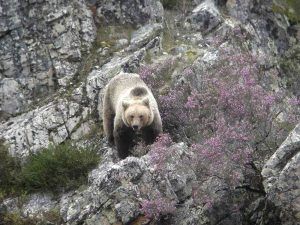
The Cantabrian brown bear population has grown rapidly over the last decade, making it possible to spot them with a high degree of success at certain times of the year. The best times for sightings are spring and summer-autumn.
Observation is always carried out from one side of the valley to the other, using observation points authorised and designated by the nature conservation authorities, which are situated at varying distances from the hills most frequented by plantigrades, but which are often around 800–1,000 metres away, or even further.
The bear roams the mountains of Riaño and the Cantabrian Mountains all year round, except during the winter months. The best times for spotting them are from April to early June, when, having emerged from hibernation, the animals are very active in their search for food and during the rutting season; and from mid-August to October, when the bears prepare for hibernation and regularly visit fruit trees or beech forests in search of food.
There have been good opportunities to spot bears in the Riaño Mountains in recent years, and this is likely to continue as the population in this Regional Park is clearly on the rise. However, the best viewing areas are located in the western part of the Cantabrian Mountains, so we usually travel to other natural areas to work with this species.
The Cantabrian brown bear inhabits a variety of mountain habitats (beech and oak forests, blueberry thickets, high-altitude grasslands and areas with wild fruit trees) depending on the time of year and the availability of food. For this reason, on each outing we select the most suitable locations to maximise the chances of spotting the species, always with respect and keeping a safe distance.
To enjoy this activity, we recommend wearing a telescopeHowever, bears can sometimes be spotted in closer locations, and it is possible to capture high-quality images using high-magnification lenses (for example, a 600mm lens with a 1.4x teleconverter). However, the distances are usually too great for photography. If you are interested in taking advantage of specific opportunities to photograph bears, we recommend that you stay in regular contact with the Aveshide team to receive up-to-date information.
This activity usually takes place in the mountains, so we recommend wearing warm, layered clothing to keep warm. It is also advisable to wear muted, dark colours (such as black or green) that blend in easily with the surroundings.
Combine this experience
Both destinations
One person
240€
Montaña de Riaño
Two or more people
150€
/person
Price
Somiedo/Asturias
Two or more people
180€
/person
- Riaño Mountain (meadows and stream banks)
- July to December, with the possibility of good sightings in spring.
- 1 to 4 people per guide.
-
Species distance
20–60 m - 300–500 mm telephoto lenses; 500–600 mm telephoto lenses with a 1.4x teleconverter.
- Mornings and afternoons.
- Low (activities from a vehicle and short walks).
- Photography and Observation
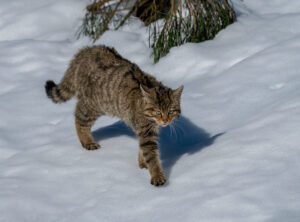
The activity involves searching for this feline in the grassy pastures of the Riaño mountains, where it usually hunts.
We’ll mainly be travelling by car, although we’ll go for short walks that aren’t physically demanding.
Given the distances at which we might encounter these animals, lenses with a focal length of 300 mm to 600 mm are recommended.
Las mejores épocas para esta actividad son desde el mes de julio, tras la siega hasta el invierno. También se puede observar en noviembre y diciembre, aunque en ocasiones se consiguen buenos resultados en algunas fases tempranas de la primavera.
There have been good opportunities to spot bears in the Riaño Mountains in recent years, and this is likely to continue as the population in this Regional Park is clearly on the rise. However, the best viewing areas are located in the western part of the Cantabrian Mountains, so we usually travel to other natural areas to work with this species.
The Cantabrian brown bear inhabits a variety of mountain habitats (beech and oak forests, blueberry thickets, high-altitude grasslands and areas with wild fruit trees) depending on the time of year and the availability of food. For this reason, on each outing we select the most suitable locations to maximise the chances of spotting the species, always with respect and keeping a safe distance.
To enjoy this activity, we recommend wearing a telescopeHowever, bears can sometimes be spotted in closer locations, and it is possible to capture high-quality images using high-magnification lenses (for example, a 600mm lens with a 1.4x teleconverter). However, the distances are usually too great for photography. If you are interested in taking advantage of specific opportunities to photograph bears, we recommend that you stay in regular contact with the Aveshide team to receive up-to-date information.
This activity usually takes place in the mountains, so we recommend wearing warm, layered clothing to keep warm. It is also advisable to wear muted, dark colours (such as black or green) that blend in easily with the surroundings.
Combine this experience
- Riaño Mountain and the Picos de Europa National Park.
- Mid-November to mid-December.
- 1 to 4 people per guide.
-
Species distance
10–30 m - 300–400 mm telephoto lenses.
- Mornings with soft light.
- Moderate (access to higher ground).
- Photography and observation
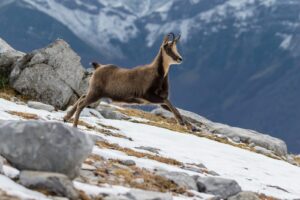
The Cantabrian chamois can be observed and photographed for most of the year. The rutting season is a fascinating time, when the males compete for harems of females on steep, high-altitude slopes, which are often covered in snow.
During this activity, you can photograph the animals at close range whilst they behave completely naturally and are entirely oblivious to the observer.
Although this species can be observed throughout the year, the most interesting period is from mid-November to mid-December, when the mating season takes place.
The tour takes in various locations in the Riaño Mountains and the Picos de Europa National Park, searching for wildlife amongst the hillsides and valleys. The atmosphere and mountain scenery surrounding the animals lend a distinctive character and a special charm to the photographs, which will remain an indelible memory for the photographer.
Encounters occur at close range, sometimes as little as 10–15 metres, and sometimes even less! We recommend binoculars with a magnification of between 200 mm and 500 mm (and shorter focal lengths to capture the stunning scenery).
This activity takes place in the mountains, mainly in winter, so it is advisable to dress in layers, starting with a warm thermal base layer.
Combine this experience
- Riaño Mountain and the Picos de Europa National Park.
- May to September
- 1 to 4 people per guide.
- Very tame birds just a few metres away
- 300–400 mm telephoto lenses.
-
Mornings and afternoons, 7.00 am–1.00 pm
15:00-21:00 - Moderate (short walks; access by authorised vehicle).
- Photography and observation
This excursion takes place within the Picos de Europa National Park at an altitude of over 2,200 metres (an activity authorised by the National Park). Access to the photography spot involves a walk, which is generally easy and never too long.
The birds in this area are very trusting, so photography involves waiting patiently, allowing the birds to approach the observer of their own accord.
We will focus on spotting the Alpine accentor, white-winged snowfinch, wallcreeper and alpine chough. During our time in the area, we have also photographed other species such as the northern wheatear, bearded vulture, stoat and chamois.
The trip is available from May to September. However, heavy snowfall and weather conditions can affect access to and movement within the photography area, so this activity is usually only feasible from late May or early June.
Alpine birds inhabit the highest and most isolated peaks of the Picos de Europa National Park, in high-altitude limestone areas above 2,200 metres. These birds live in areas where they do not perceive humans as a threat; consequently, they do not shy away from our presence and behave naturally just a few metres away from the observer.
This makes for an intense, exciting and spontaneous experience, and one that is completely different every day. The activity combines high-mountain scenery, iconic wildlife and exceptional photo opportunities.
Very tame birds, which can be observed from just a few metres away. Recommended telephoto lenses: 300–400 mm; some more elusive species may require 500–600 mm.
The physical exertion is moderate, as the route involves a walk along an easy, not overly long path; in some seasons there may be snow, in which case snowshoes are required.
- June is the key month for photographing the white-winged snowfinch, as this species moves to even higher altitudes shortly after the chicks have fledged, in early July.
- The wallcreeper is one of the most difficult species to photograph due to its skittish nature and the type of habitat it inhabits (scree slopes and rocky cliffs), but generally good results can be achieved from June to September, when both adults and this year’s chicks remain in their breeding grounds.
- The alpine accentor and the alpine chough are present all year round.
- The recovery of the bearded vulture population in the Picos de Europa means that the bird is becoming an increasingly common sight, and it is now possible to photograph some birds in flight, sometimes at close range.
Combine this experience
- Riaño Mountain, altitudes 1,800–2,000 m.
- Late April to late July.
- 4–6 people
- 5–30 m.
- 300–400 mm telephoto lenses.
- Tomorrow: 7.00 am–1.00 pm and 3.00 pm–9.00 pm.
- Moderate (short walks; access by authorised vehicle).
- Photography and observation
This experience combines travel by 4×4 with short walks and photo sessions in portable hides, allowing you to capture birds in their natural habitat and within the mountain landscape. These spots are accessed on foot, but the walks are generally easy and short.
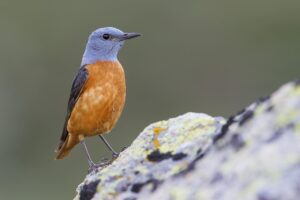
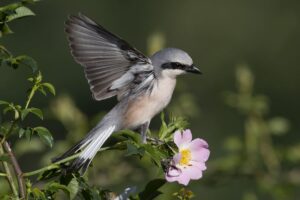
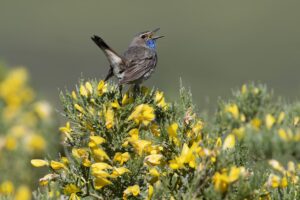
The main species we will be looking for are: common rock thrush, bluethroat, ring ouzel, northern wheatear, water pipit, tawny pipit, rock bunting and common whitethroat.
The season for this activity runs from late April to late July.
- In April, the water pipit can be photographed in its finest breeding plumage, when the adults display an orange or salmon-coloured hue on their underparts.
- Bluethroats can be photographed singing from the tops of broom bushes or lichen-covered rocks, preferably in May and June; from mid- to late May onwards, this coincides with the flowering of the mountain broom or the Mediterranean broom.
- The common rock thrush arrives in the area to nest between mid- and late May, although there can be significant variation from year to year. It can be photographed from that time until mid-July.
- The ring ouzel is one of the most elusive species in the area, going completely unnoticed most of the time. Incredibly, it is able to nest in the area from April onwards, even when the whole mountain may appear to be covered in snow. The best time to photograph it is from early May to mid-June.
Subalpine birds nest in valleys and on slopes at altitudes of between 1,800 and 2,000 metres in the Riaño Mountains, where we will look for them amongst lichen-covered rocks and groves of broom. The morning and evening light brings out the beauty of the birds and the landscape. Weather conditions and the presence of snow influence our activities; every day is unique.
Snow cover and weather conditions during the winter and spring affect access to this photography spot. However, from late April or early May onwards, it is usually possible to reach the highest point by 4x4. We therefore recommend contacting our office well in advance so that we can organise trips during this period as effectively as possible.
The tour is limited to a maximum of 4–6 people per guide. Whilst the activity is not particularly strenuous, it does involve walking in the mountains; therefore, a good level of fitness is required.
For photography, we recommend using telephoto lenses with a focal length of 300 mm or more.
Combine this experience
Guided tours
Biologists and nature guides with years of experience.
Commitment
Experiences certified for their sustainability and their contribution to conservation.
Key habitats
Access to locations selected for their high probability of sightings, where the mammals display their natural behaviour.
The perfect addition to your hide experiences
They offer a broader perspective on the natural environment and wildlife of the Cantabrian Mountains. Whilst hides allow for close-up photography and attention to detail, field trips open up a view of the landscape, the interaction between species and their behaviour in the wild. These excursions form an integral part of the Wild Spain Travel experience, designed for those who wish to immerse themselves in nature in its entirety: wildlife, scenery and adventure.
Reservations
Prices
Iberian wolf
One person
240€
/exit
Two or more people
150€
/person
Cantabrian brown bear
Montaña de Riaño
150€
/person
Minimum of 2 people per trip
Somiedo
Asturias
180€
/person
Minimum of 2 people per trip
One person
240€
Montaña de Riaño
and Somiedo/
Asturias
Wildcat
Two or more people
150€
/person
One person
240€
/exit
Half-day excursion with transport included
Cantabrian chamois
Two or more people
150€
/person
One person
240€
/exit
Half-day excursion with transport included
Alpine Bird Safari
Two or more people
180€
/person
One person
240€
/exit
Half-day excursion with transport included
High-altitude birdwatching safari
Two or more people
150€
/person
One person
240€
/exit
Half-day excursion with transport included
Design your own tailor-made adventure
We’ll help you choose the route and activities based on the weather and your preferences.